
Every enterprise has experienced this problem in some form: a market opportunity emerges, a regulatory requirement changes, or a competitor introduces a capability that demands a response. The technology team assesses what is needed and returns with an estimate: six months, twelve months, longer. The delay is not a resourcing problem or a skills problem. It is an architecture problem. The software the organisation depends on was built as a single interconnected system, and changing any part of it requires touching all of it.
This is the defining constraint of monolithic software architecture, and it is the reason composable architecture has moved from a technical concept to a strategic priority for enterprise IT leaders. The ability to change, extend, and reconfigure software at the pace business decisions are made is no longer a competitive advantage. For most industries, it has become a baseline expectation. Gartner research spanning more than 2,000 CIOs found that 63% of organisations with high composability reported superior business performance compared with peers. The architecture a business chooses is not a technical decision. It is a business performance decision.
What Composable Software Architecture Actually Means
Composable software architecture is an approach to building software from discrete, independently deployable components, each with clearly defined boundaries and interfaces, connected through standardised APIs. Rather than building an application as a single codebase where every capability is tightly coupled to every other, composable architecture assembles solutions from components that can be developed, updated, replaced, or reused without affecting the rest of the system.
The practical implication is significant. In a monolithic system, adding a new capability or changing an existing one requires careful coordination across the entire codebase. A change to the claims intake module affects the reporting module. A change to the identity management layer requires regression testing across every function that touches it. Deployment is a whole-system event, which means every release carries the risk of the entire system. In a composable system, the claims intake component can be updated and deployed independently. The reporting component does not know or care that it changed. The scope of risk is bounded by the scope of the component.
These components are sometimes described as microservices or building blocks: discrete units of capability that communicate via APIs and can be independently deployed, upgraded, or replaced. The defining characteristic is not the specific technical pattern used to implement each component but the deliberate separation of business capabilities into reusable, independently governable units that can be assembled into solutions without coupling the whole system together.
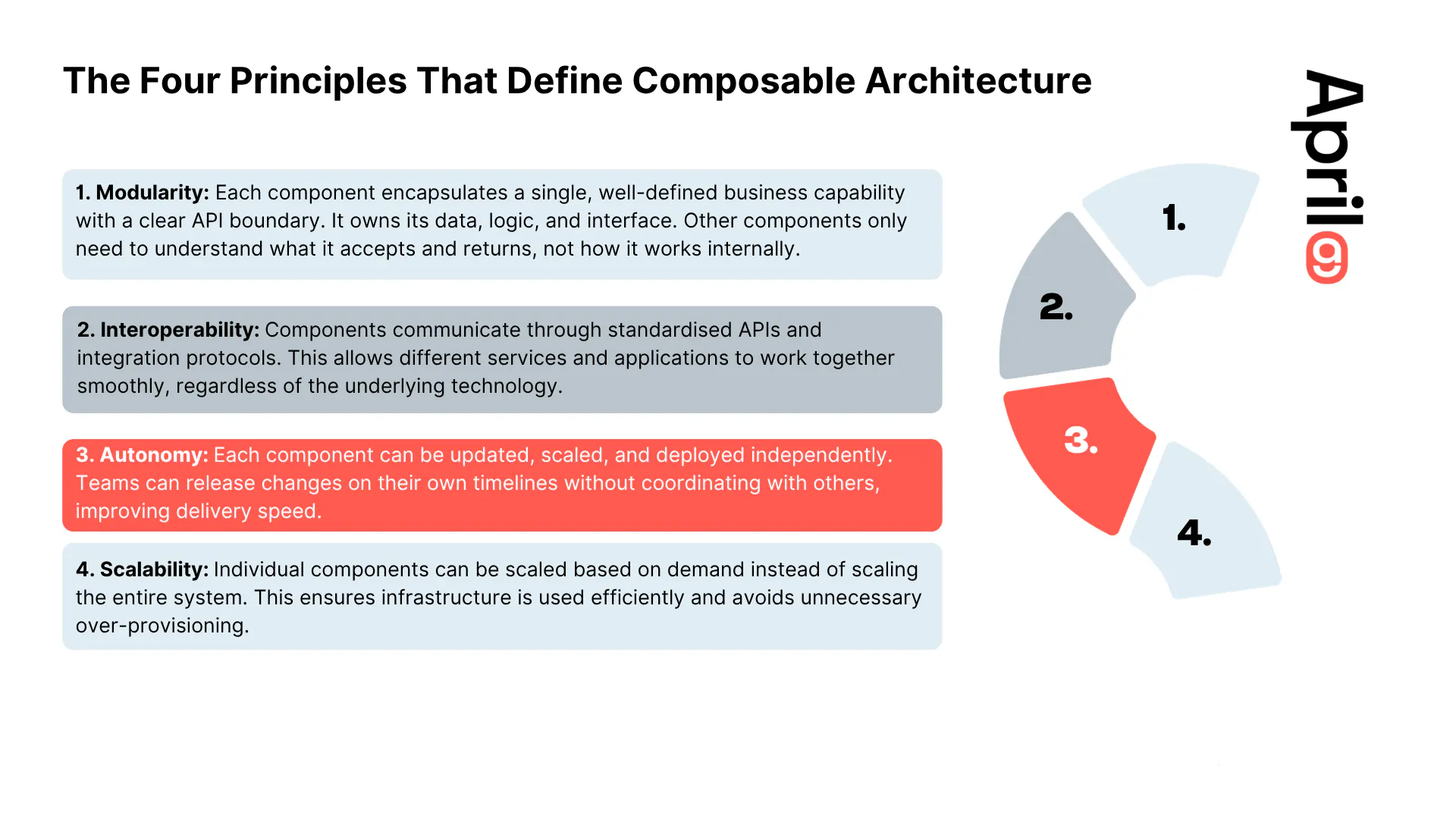
The Four Principles That Define Composable Architecture
Four characteristics distinguish genuinely composable architecture from systems that are merely modular in name.
Why Enterprises Are Moving Away From Monolithic Systems
The problem with monolithic systems is not that they were built badly. Most were built rationally for the requirements that existed at the time. The problem is that they accumulate coupling over time. Every integration, every shortcut, every workaround adds a connection between components that was never meant to be permanent but becomes structural. The system that was manageable at launch becomes expensive to change at scale.
The decision an organisation faces when its monolithic system reaches this point is explored in detail in the context of brownfield versus greenfield development, but the architectural question underneath it is always the same: can this system be extended to meet the next set of requirements, or is the cost of extension now higher than the cost of replacement?
Generic SaaS platforms offer an alternative, but one with its own constraints. Off-the-shelf software solves the problems it was designed to solve. When an organisation's requirements diverge from the vendor's standard model through integration complexity, compliance obligations, workflow specificity, or scale, the SaaS option typically requires customisation that erodes its cost advantage and creates its own coupling to a vendor's release cycle and data model. The promise of instant capability becomes a dependency that is difficult to exit.
Composable architecture addresses both problems. It provides the speed and reuse of a platform without the constraints of a vendor's feature set. And it addresses the coupling problem at the design level rather than inheriting it through integration workarounds.
What Composable Architecture Delivers in Practice
The practical outcomes of composable architecture are measurable across three dimensions.
Speed. Because components are pre-built, tested, and reusable, new solutions are assembled rather than built from scratch. The development effort concentrates on the specific requirements of the new solution, typically around 20% that is unique, rather than rebuilding the 80% that is common across enterprise software. This directly reduces time to delivery.
Cost. Reuse reduces the cost of each new solution. Integration patterns established for one project are available to the next. Security and compliance controls built into the component library do not need to be rebuilt for each engagement. The cost of each new capability decreases as the library matures.
Adaptability. When requirements change, a composable system responds at the component level rather than the system level. Adding a new claim type does not require a new platform. Changing a reporting output does not require touching the intake workflow. The scope of change is proportional to the scope of the requirement.
Related Reading: Composable Architecture: The Secret Weapon for Building Flexible IT Systems
How Stack9 Implements Composable Architecture for Enterprises
Stack9 is April9's composable software platform, built on the principles above and deployed across enterprise and government environments in Australia and globally. The platform is used by over 800,000 people worldwide and has supported more than $65 million in transactions.
Stack9 implements the 80/20 composable model: 80% of solution requirements are delivered through low-code configuration of the pre-built component library, with the remaining 20% addressed through traditional custom development where requirements are genuinely unique. This model delivers a 50% reduction in development time and a 40% cut in implementation costs compared with fully bespoke development, while retaining the ability to build exactly what the organisation requires for the capabilities that cannot be met through configuration.
The platform provides 20+ pre-built applications spanning documents, CRM, case management, marketing automation, customer portals, supply chain, scheduling, e-commerce, and more. Each component is built to enterprise security standards: Stack9 is ISO 27001 certified and PCI compliant, meaning security and compliance architecture is a structural property of the platform rather than an obligation managed separately for each engagement.
Related Reading: The April9 Journey: From Bespoke to Composable Solutions
Composable Architecture in Action
The outcomes Stack9 delivers in practice are visible across April9's client engagements in distinct sectors.
For Eagers Automotive's easyauto123 business, April9 delivered a composable solution covering website redesign, e-commerce capabilities, and integrated inventory and marketing automation. The result was a 20% reduction in operational costs in under a year, with improved sales efficiency and customer experience across a business operating across more than ten locations.
For Gallagher Bassett and Comcover, the Australian Government's self-managed insurance fund, April9 delivered an IRAP-certified composable platform covering online claim forms across five claim types, a business intelligence platform, identity management, and Dynamics CRM integration. The platform delivered a 30% reduction in claims processing time and a 25% reduction in operational costs, and has maintained zero security breaches since implementation.
Both engagements reflect the same architectural principle: reusable components assembled into a purpose-built solution, with the integration layer managed as a structural property of the platform rather than a project-specific workaround.
Architecture Is a Strategic Decision, Not a Technical One
The architecture choices organisations make today determine their capacity to respond to change in the years ahead. A system built on composable principles can absorb a new regulatory requirement, a new product line, or a new channel without a system-wide project. A monolithic system treats every change as a risk to the whole. The compounding cost of that risk is what eventually forces the replacement cycle that composable architecture is designed to prevent.
For enterprise IT leaders evaluating how to build or extend software capability, the architectural question is inseparable from the strategic one. April9's custom software development services are built around Stack9's composable foundation, meaning every engagement contributes to a component library that grows more valuable with each project rather than producing a standalone system that ages in isolation. For enterprise IT leaders ready to explore what composable architecture could deliver for their organisation, the April9 team is well placed to help. Get in touch through the April9 to start a conversation.
Further Reading: How Gallagher Bassett and the Department of Finance Enhanced Compliance and User Experience in Under a Year